Clubhouse Troubles Emerge
Many people were excited about the release of Clubhouse. A two-way audio social app where users didn’t just listen, they could join the conversation. Guardian writer Rafqa Touma summarized it neatly: “Part talkback radio, part conference call, part Houseparty, Clubhouse is a social networking app based on audio-chat. Users can listen in to conversations, interviews, and discussions between interesting people on various topics – it is just like tuning in to a podcast, but live and with an added layer of exclusivity.”
At its peak, Clubhouse had 10 million weekly active users, partially attributed to the pandemic. Today, the number is less, but the cooling-off period is only natural. The sheen wears off and with new users come new ideas, opinions, and agendas, When a social media app proclaims itself to be kinder and more gentle with the ban hammer, invariably some radicals slip into the rooms, and before long, there’s animosity and outright hate speech.
Anti-semitism usually rears its ugly head usually early in this process, followed by radical right-wingers, radical leftists. At some point, even the most generous admins of a social app have to draw a line. Free speech is one thing – suggesting that one group of people must be killed, segregated or otherwise “removed from society” is simply unacceptable by any standard.
As Clubhouse has now been around for some time, the ‘crazies’ (as one user noted) have started showing themselves. It was clear that Clubhouse needed to take action but rather than developing a top-down adjudication process, Clubhouse introduced a way for users to block other users.
From “The Atlantic”
“When you block someone on Clubhouse, it doesn’t just affect communications between the two of you, as it would on Facebook or Twitter. Rather, it limits the way that person can communicate with others too. Once blocked, they can’t join or even see any room that you create, or in which you are speaking—which effectively blocks them for everyone else in that room. If you’re brought “onstage” from the audience to speak, anyone else in the audience whom you have blocked will be kept off the stage for as long as you’re up there. And if you’re a moderator of a room, you can block a speaker and boot them from the conversation in real time—even if they’re mid-sentence.
Imagine a live panel discussion in which each member of the panel has the power to cut the mic of any other member, at any moment and for any reason, and also the power to have that person dragged from the lecture hall by security. That’s roughly how blocking works on Clubhouse. This is not just a personal decision, but a social act, with implications for who can speak at what times and in what settings.
There’s even a visible emblem of this regime. When a user you don’t follow has been blocked by some unspecified number of people whom you do, that user’s profile will appear on your app with an ominous icon: a black shield with a white exclamation point. Clubhouse calls this feature a “shared block list.” Some users call the badge the “black checkmark” (or even the “black mark of the damned”), as if it were an inversion of Twitter’s blue checkmark, signaling notoriety instead of notability. While others can see it on a user’s profile, the user herself cannot—and most don’t even realize they’ve been marked until someone else breaks the news.”
This is actually a good way to go, according to some users. Effectively, this gives individuals the power to control speech not only for themselves but for one another—and to affix warning labels to one another’s profiles. By doing it this way, Clubhouse has pretty much created a system of self-moderation, in which the complex questions of online speech are passed on to its users. Such an approach is easily scalable which removes the need for Clubhouse employees to make top-down content decisions or adjudicate disputes. It can also help people feel safe when discussing sensitive topics, such as sex, race, and mental health since it gives them a simple way to protect their conversations from trolls.
At some point, all social media platforms find themselves trying to enforce moderation policies, with few exceptions.
Gab is a social media platform that has become a hot spot for far-right figures like Infowars founder Alex Jones as well as white supremacist and anti-Semitic rhetoric since it launched in 2016. That’s because it doesn’t moderate content as Twitter does — Gab markets itself as a vehicle for free speech and doesn’t crack down on posts that would be considered hateful or contain false information.
Since launching in 2016, Gab has been suspended by Stripe, PayPal, Amazon’s cloud-hosting service, Google’s cloud platform, Apple’s app store, and its former domain registrar GoDaddy over hate speech violations. And in 2018, the shooter of the Tree of Life Pittsburgh synagogue attack took to Gab to voice anti-Semitic rhetoric before killing 11 people. Now, after Facebook and Twitter banned President Trump from their platforms following the US Capitol siege, many on the right are flocking to sites like Gab — the company said it’s seeing 10,000 new users every hour, but Apple and Google have long banned it from their app stores.
Parler, another social media app that embraced free-speech above all else, found itself at the center of a controversy surrounding the January 6th, 2020 incident.
As the country scrambled to understand what was unfolding at the Capitol, those storming the building uploaded selfies, live video, and status updates in real-time to a handful of popular social media platforms—including the relatively new, but rapidly growing, platform called Parler.
The rally and march that led to crowds fighting Capitol police, scaling the Capitol walls, and ultimately breaking into the halls of Congress were the culmination of a months-long #StopTheSteal movement that unfolded across the internet—from social media platforms to event planning and ticketing websites, crowdfunding campaigns, and independent online message boards. And though it was clear to many journalists, researchers, and community organizers that major platforms like Facebook and Twitter were early social media hubs for #StopTheSteal content and organizing, the sheer volume of evidence uploaded to Parler on Jan. 6 turned a spotlight on the lesser-known platform in the hours and days immediately following the attack.
Within 48 hours, the Parler app had been suspended by both the Google Play Store and the Apple App Store. It wasn’t long before Amazon Web Services, Parler’s web host, followed suit, forcing the platform’s operational back-end offline and rendering it inaccessible to users.
Parler was back on the App stores in August of 2020, only after they agreed to content moderation.
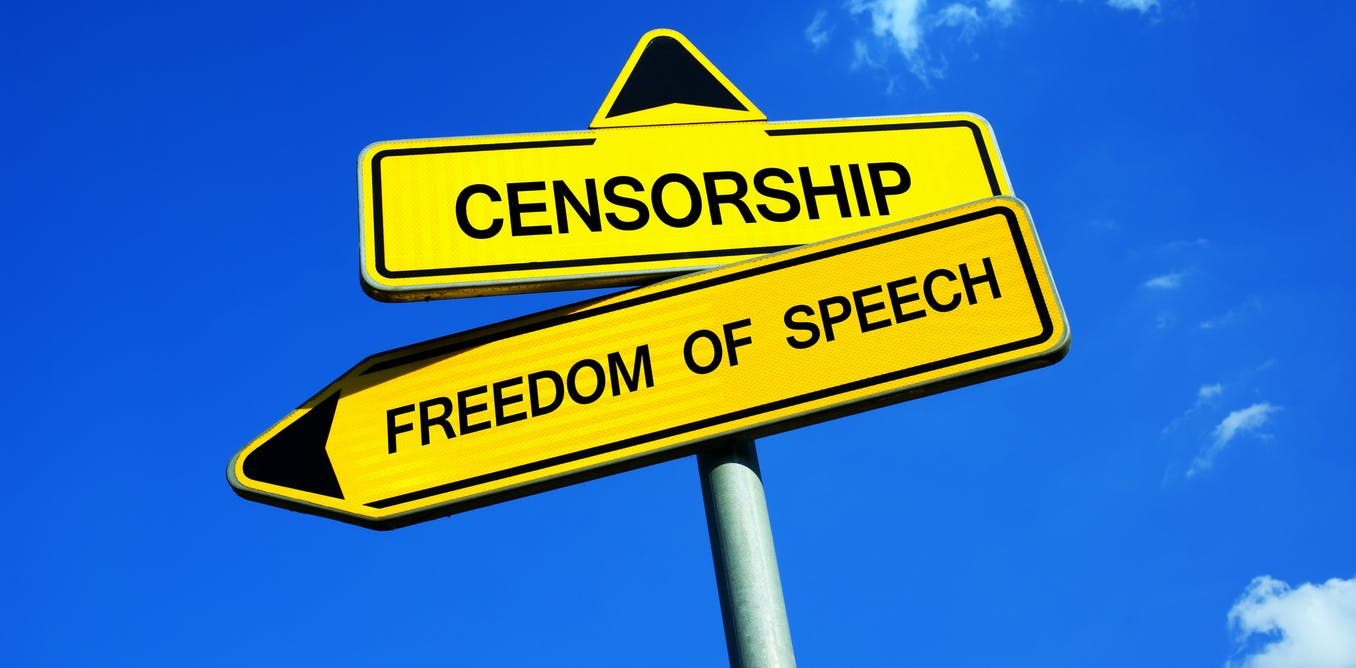
Where is the middle ground? If a social media app doesn’t want to get banned from the App stores, or taken down by its domain registrar or hosting provider, who actually determines what’s free speech and what’s hate speech?
It’s a slippery slope. There’s no place where overreach is more prevalent than on Facebook. Facebook was recently forced to admit that their “fact checkers” are really just paid companies who are there to insert their opinions as facts. Facebook continues to suppress voices so well that dictators of the early 20th century would have been envious.