Censorship in Social Media
A recent study shows that Americans have complicated feelings about their relationship with big technology companies. While they have appreciated the impact of technology over recent decades and rely on these companies’ products to communicate, shop, and get news, many have also grown critical of the industry and have expressed concerns about the executives who run them.
This has become a particularly pointed issue in politics – with critics accusing tech firms of political bias and stifling open discussion. Amid these concerns, a Pew Research Center survey conducted in June finds that roughly three-quarters of U.S. adults say it is very (37%) or somewhat (36%) likely that social media sites intentionally censor political viewpoints that they find objectionable. Just 25% believe this is not likely the case.
Majorities in both major parties believe censorship is likely occurring, but this belief is especially common – and growing – among Republicans. Nine-in-ten Republicans and independents who lean toward the Republican Party say it’s at least somewhat likely that social media platforms censor political viewpoints they find objectionable, up slightly from 85% in 2018, when the Center last asked this question.
At the same time, the idea that major technology companies back liberal views over conservative ones is far more widespread among Republicans. Today, 69% of Republicans and Republican leaners say major technology companies generally support the views of liberals over conservatives, compared with 25% of Democrats and Democratic leaners. Again, these sentiments among Republicans have risen slightly over the past two years.
Debates about censorship grew earlier this summer following Twitter’s decision to label tweets from President Donald Trump as misleading. This prompted some of the president’s supporters to charge that these platforms are censoring conservative voices.
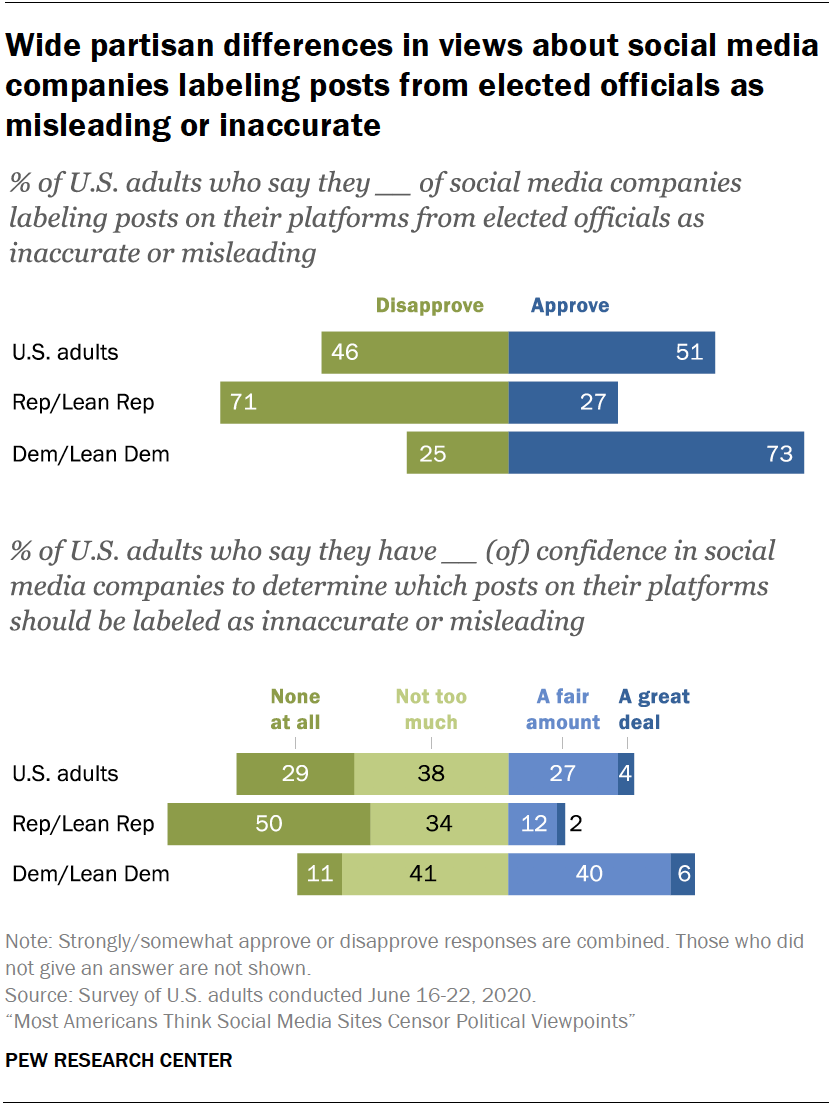
This survey finds that the public is fairly split on whether social media companies should engage in this kind of fact-checking, but there is little public confidence that these platforms could determine which content should be flagged.
Partisanship is a key factor in views about the issue. Fully 73% of Democrats say they strongly or somewhat approve of social media companies labeling posts on their platforms from elected officials as inaccurate or misleading. On the other hand, 71% of Republicans say they at least somewhat disapprove of this practice. Republicans are also far more likely than Democrats to say they have no confidence at all that social media companies would be able to determine which posts on their platforms should be labeled as inaccurate or misleading (50% vs. 11%).
So while the discussions about political affiliations continue among users, there are a few things that are not in dispute. For starters, Facebook is undeniably left-wing and they make no bones about it.
Social media start-ups like Parler and of course, Breakout, have stated publicly that they will not censor the content posted by users (so long as there are no threats of violence and various exceptions as delineated in each provider’s terms of service.)
The problem is that the measurement of what constitutes a “violation” is subject to human interpretation. When AI bots get tasked with making this determination, it seems to be either too restrictive or too loose, depending on who you ask.
So what’s the happy medium? The free market will likely determine the winners – and the losers. The established players in this space have a huge headstart, given that Facebook has nearly 3 billion users.
One thing for sure is that a monopoly is bad for everyone – except the owners of that monopoly.
When Breakout was created, part of its allure was the policy of not restricting free speech. To sweeten the part, the founders developed a new way to help users monetize their content and usage of the platform. It is proving to be attractive with early adopters -and with early investors.
Who Does Censorship in Social Media Hurt the Most?
The answer is simple: the person or persons who get hurt the most are those who are telling the truth. Facts don’t care about feelings, as it’s said. But “news reporters” have become experts in twisting, spinning and clouding the facts. But somewhere in their spins, the truth exists. And somewhere, there are people who are telling the truth.
Censorship is a dangerous and slippery slope. History has shown us that governments that believe in censorship have never been on the right side of history.